Security teams face an impossible equation: defending against sophisticated attackers who operate 24/7 while struggling with limited resources, alert fatigue, and a persistent talent shortage. With the average data breach now costing organizations $4.45 million and ransomware attacks increasing 41% month-over-month in late 2025, the traditional approach of relying solely on security tools has reached its breaking point.
Enter managed detection and response (MDR) – a rapidly growing security service that fundamentally changes how organizations approach threat detection and response. The MDR market's explosive 21.95% to 23.5% compound annual growth rate reflects a critical shift: organizations are moving from tool-centric to service-centric security strategies, recognizing that technology alone cannot keep pace with modern threats.
This comprehensive guide examines how MDR services combine advanced technology with human expertise to deliver round-the-clock threat detection, investigation, and response capabilities. Whether you're evaluating MDR for the first time or comparing providers, you'll learn exactly how these services work, what differentiates them from alternatives like EDR and XDR, and how to select the right approach for your organization's security needs.
Managed detection and response (MDR) is a comprehensive cybersecurity service that combines advanced security technology with human expertise to provide organizations with 24/7 threat monitoring, detection, investigation, and response capabilities. Unlike traditional security tools that require internal teams to operate and interpret, MDR delivers security outcomes as a fully managed service, fundamentally changing how organizations protect themselves against modern threats.
At its core, MDR addresses a critical gap in cybersecurity: the vast majority of organizations lack the resources, expertise, or round-the-clock coverage needed to effectively detect and respond to sophisticated attacks. According to industry research, organizations using MDR services reduce their average threat detection time from 277 days to minutes, a transformation that can mean the difference between a minor security incident and a catastrophic breach.
The explosive growth of the MDR market underscores its critical importance. With a market size projected to reach $11.3 to $11.8 billion by 2030, driven by consistent annual growth rates exceeding 20%, MDR has evolved from a niche offering to an essential component of modern security strategies. This growth reflects both the increasing sophistication of cyber threats and the recognition that traditional, tool-centric approaches to security are no longer sufficient.
The effectiveness of MDR stems from five essential components that work together to deliver comprehensive security coverage. First, prioritization and alerting systems use advanced analytics to surface the most critical threats from the noise of daily security events. Rather than overwhelming teams with thousands of alerts, MDR services focus attention on genuine threats requiring immediate action.
Threat hunting capabilities represent the proactive element of MDR, with security experts actively searching for hidden threats that automated tools might miss. These hunters leverage threat intelligence, behavioral analysis, and years of experience to identify sophisticated attackers who have evaded initial detection layers.
Investigation services provide deep forensic analysis when threats are detected, determining the scope, impact, and root cause of security incidents. This investigative depth goes far beyond simple alert validation, providing organizations with comprehensive understanding of attack chains and adversary tactics.
Guided response actions ensure organizations take the right steps to contain and eliminate threats. Rather than leaving teams to figure out remediation on their own, MDR services provide specific, actionable guidance tailored to each threat scenario. Finally, remediation support helps organizations not just respond to immediate threats but also address underlying vulnerabilities to prevent future attacks.
These components integrate seamlessly with existing security operations center workflows, enhancing rather than replacing current security investments. The result is a force multiplier effect that dramatically improves an organization's security posture without requiring massive internal team expansion.
The operational model of MDR services follows a sophisticated yet streamlined process designed to maximize both speed and accuracy in threat detection and response. Understanding this workflow helps organizations appreciate the value MDR brings beyond traditional security tools and why deployment can transform security operations in a matter of days rather than months.
Initial deployment typically ranges from 72 hours to 10 days for standard environments, with complex enterprise deployments potentially extending to 90 days. This rapid implementation stands in stark contrast to traditional security infrastructure projects that can take months or even years to fully operationalize. The speed comes from MDR providers' use of cloud-native architectures and pre-configured detection rules based on thousands of prior deployments.
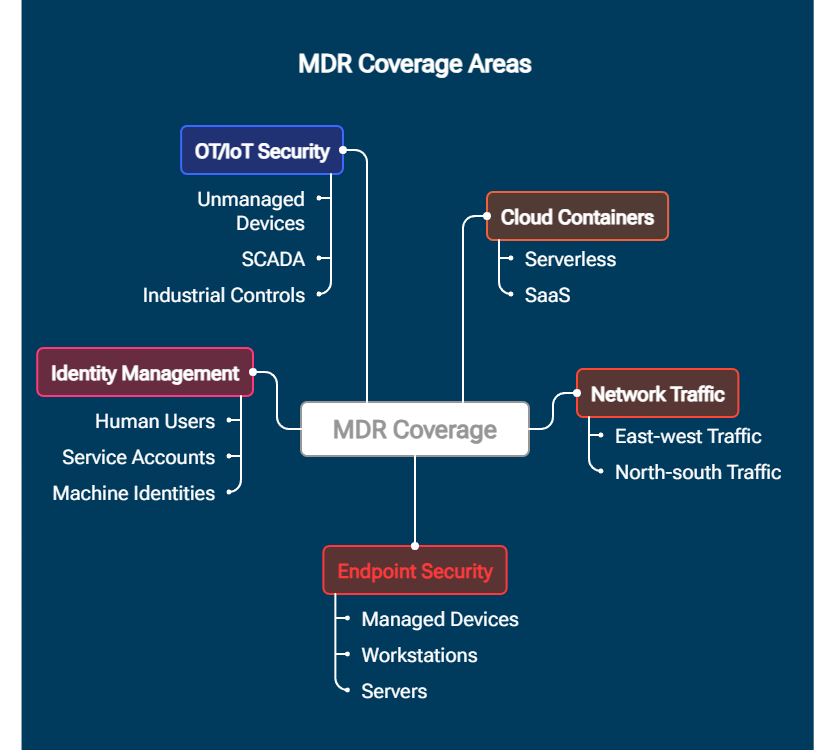
The MDR process begins with comprehensive data collection across all critical attack surfaces. Modern MDR services ingest telemetry from endpoints, network traffic, cloud workloads, identity systems, and SaaS applications. This multi-source approach ensures complete visibility across hybrid environments where attackers might move laterally between on-premises and cloud resources.
Once data collection is established, continuous monitoring engines powered by AI-driven security analyze billions of events in real-time. These systems look for known attack patterns, behavioral anomalies, and subtle indicators that might signal compromise. The combination of signature-based detection, machine learning models, and behavioral analytics creates multiple detection layers that adapt to evolving threats.
The five-step MDR workflow process, as defined by industry leaders like Microsoft and CrowdStrike, provides a structured approach to threat management. Step one involves continuous data collection from across the environment, creating a comprehensive security telemetry baseline. This isn't passive log collection – it's active, intelligent gathering of security-relevant data optimized for threat detection.
Step two leverages automated threat detection to identify potential security incidents from the massive volume of daily events. Advanced correlation engines connect seemingly unrelated activities to reveal attack chains, while machine learning models identify novel threats without relying on known signatures.
Human investigation in step three brings critical context and expertise that technology alone cannot provide. When automated systems flag potential threats, security analysts investigate to determine whether alerts represent genuine threats or false positives. This human validation dramatically reduces alert fatigue while ensuring real threats receive immediate attention.
Response recommendation in step four provides organizations with clear, prioritized actions to address confirmed threats. Rather than generic advice, MDR services deliver specific remediation steps tailored to the organization's environment and the particular threat detected. Step five extends beyond immediate response to include remediation support, helping organizations address root causes and prevent similar attacks in the future.
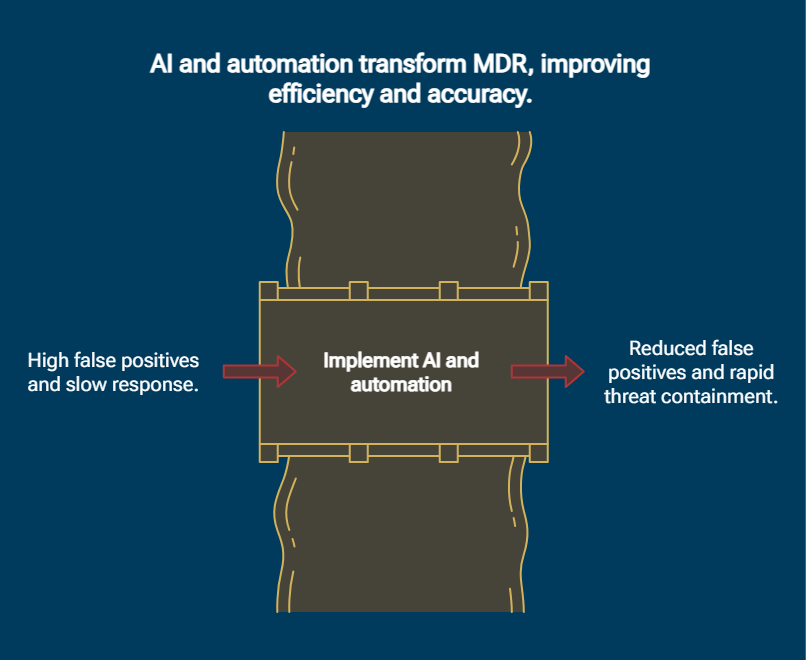
The integration of artificial intelligence and automation has revolutionized MDR capabilities in 2025, with the majority of initial triage now handled autonomously through advanced AI systems. This dramatic shift doesn't eliminate human expertise but rather focuses it where it matters most – complex investigations and strategic threat hunting.
Modern MDR platforms achieve an 85% reduction in false positives through advanced machine learning models trained on millions of security incidents. These models continuously improve through feedback loops, becoming more accurate at distinguishing genuine threats from benign anomalies. Virtual analysts powered by generative AI can now conduct initial investigations, gather context, and even draft initial incident reports for human review.
Real-time predictive security represents the cutting edge of MDR innovation. By analyzing patterns across thousands of customer environments, MDR services can predict and prevent attacks before they materialize. When a new attack technique emerges against one customer, protective measures immediately deploy across all customers, creating a powerful network effect.
The automation extends to response actions as well. Pre-approved playbooks enable immediate containment of confirmed threats, such as isolating compromised endpoints or disabling compromised accounts. This autonomous response capability is crucial when dealing with ransomware or data exfiltration attempts where every second counts. However, human oversight remains essential for complex decisions and situations requiring business context that automated systems cannot fully understand.
Integration with existing SIEM platforms ensures MDR services enhance rather than replace current security investments. APIs and standardized data formats enable seamless information sharing, creating a unified security ecosystem that leverages the strengths of both managed services and internal tools.
The MDR market has evolved to offer diverse service models tailored to different organizational needs, technical requirements, and budget constraints. Understanding these variations helps organizations select the most appropriate MDR approach for their specific security challenges and operational realities.
Traditional endpoint-focused MDR services represent the original and still most common deployment model. These services concentrate on protecting laptops, desktops, and servers through agent-based monitoring and response capabilities. While limited in scope compared to newer offerings, endpoint MDR remains highly effective for organizations primarily concerned with device-level threats and looking for straightforward deployment.
Extended MDR (MXDR) has emerged as the next evolution, providing comprehensive coverage across cloud security, identity systems, network traffic, and SaaS applications. MXDR services recognize that modern attacks rarely confine themselves to a single attack vector. By correlating signals across multiple domains, MXDR can detect sophisticated attacks that traditional endpoint-only services might miss.
Industry-specific MDR solutions address the unique security and compliance requirements of heavily regulated sectors. Healthcare MDR services, for instance, include specific capabilities for protecting patient data and meeting HIPAA requirements. Financial services MDR incorporates fraud detection and PCI DSS compliance monitoring. These specialized offerings go beyond generic security to address sector-specific threat patterns and regulatory obligations.
Enterprise MDR services cater to large organizations with complex, distributed environments and sophisticated security requirements. These offerings typically include custom detection rules, dedicated threat hunting teams, and integration with extensive security tool stacks. Enterprise MDR providers offer flexible deployment models, including on-premises components for organizations with data residency requirements.
Mid-market MDR strikes a balance between comprehensive coverage and cost-effectiveness. These services typically offer standardized detection capabilities with some customization options. Mid-market providers focus on delivering enterprise-grade security outcomes without the complexity and cost of full enterprise deployments.
Small and medium business (SMB) MDR addresses a rapidly growing market segment, with search volume for "MDR for small business" reaching 90 queries monthly. SMB-focused MDR services emphasize simplicity, affordability, and rapid deployment. Providers in this segment often bundle endpoint security software with their MDR services, offering a complete security solution rather than just monitoring and response.
The SMB market represents a significant growth opportunity for MDR providers. Small businesses face the same sophisticated threats as enterprises but lack dedicated security teams. MDR services level the playing field, providing SMBs with access to enterprise-grade security expertise at a fraction of the cost of building internal capabilities.
Healthcare MDR services have evolved to address the unique challenges of protecting medical environments. With patient safety systems that cannot tolerate downtime and strict HIPAA compliance requirements, healthcare MDR includes specialized detection rules for medical device attacks, enhanced privacy controls, and rapid incident reporting capabilities to meet 72-hour breach notification requirements.
Financial services MDR incorporates sophisticated fraud detection alongside traditional threat monitoring. These services monitor for insider threats, account takeover attempts, and advanced persistent threats targeting financial data. Integration with fraud management systems and anti-money laundering platforms creates comprehensive protection against both cyber and financial crimes.
Cloud-native MDR solutions have emerged to address the unique challenges of protecting cloud-first organizations. These services leverage cloud-native security tools and APIs to provide deep visibility into cloud workloads, containers, and serverless functions. Unlike traditional MDR that retrofits on-premises tools for cloud monitoring, cloud-native MDR is built from the ground up for cloud architectures.
Critical infrastructure MDR addresses the unique requirements of utilities, energy companies, and other essential service providers. These services include operational technology (OT) monitoring capabilities, understanding of industrial control systems, and response procedures that account for safety and availability requirements that differ from typical IT environments.
The proliferation of security acronyms creates significant confusion for organizations evaluating protection options. With over 1,500 monthly searches for MDR comparison queries, understanding the fundamental differences between these approaches is crucial for making informed security investments.
Endpoint detection and response (EDR) represents a category of security tools, not a service. EDR platforms provide visibility into endpoint activities, detect suspicious behaviors, and enable response actions. However, EDR requires skilled security professionals to operate, interpret alerts, and execute responses. Organizations deploying EDR without adequate staffing often find themselves overwhelmed by alerts and unable to realize the technology's full potential.
MDR fundamentally differs from EDR by providing the human expertise and 24/7 operations that EDR tools require but don't include. While EDR is the engine, MDR is the complete vehicle with professional drivers. Many MDR services actually use EDR platforms as their underlying technology, adding the operational layer that transforms tools into outcomes.
The distinction between MDR and EDR becomes clear when examining operational requirements. EDR deployment requires organizations to hire, train, and retain security analysts capable of threat hunting, incident investigation, and response coordination. These professionals must work around the clock to provide continuous coverage, requiring multiple shifts and backup personnel.
MDR eliminates these staffing requirements by providing security expertise as a service. Instead of building internal capabilities, organizations leverage the MDR provider's team of security professionals. This approach delivers immediate access to experienced analysts who have investigated thousands of incidents across diverse environments.
Cost considerations often favor MDR for organizations below enterprise scale. Building a 24/7 security operations center with skilled analysts can cost millions annually in salaries alone, not counting tools, training, and infrastructure. MDR services typically cost a fraction of this amount while delivering superior detection and response capabilities through economies of scale.
The expertise gap represents another critical differentiator. EDR tools are only as effective as the people operating them. Without deep security expertise, organizations may miss subtle attack indicators or respond inappropriately to threats. MDR services bring battle-tested expertise gained from protecting hundreds or thousands of organizations, ensuring optimal use of detection technologies.
Extended detection and response (XDR) represents an evolution in security platforms, integrating detection capabilities across endpoints, networks, cloud, and email. Like EDR, XDR is fundamentally a technology platform requiring skilled operators to deliver value.
The convergence of MDR and XDR has created MXDR – managed extended detection and response. This combination delivers the best of both worlds: comprehensive technology coverage through XDR platforms operated by skilled MDR professionals. MXDR represents the current state-of-the-art in managed security services.
Organizations must carefully evaluate whether they need XDR technology, MDR services, or the combined MXDR approach. Those with strong internal security teams might benefit from XDR platforms they can operate themselves. Organizations lacking security expertise typically achieve better outcomes with MDR or MXDR services that provide both technology and operations.
Managed security service providers (MSSPs) offer broader IT security management including firewall management, vulnerability scanning, and compliance reporting. While MSSPs provide valuable services, they typically focus on prevention and compliance rather than active threat detection and response.
MDR services concentrate specifically on the detect and respond phases of the security lifecycle. This specialized focus enables deeper expertise and more sophisticated threat hunting capabilities than typical MSSP offerings. Many organizations engage both MSSPs for infrastructure management and MDR for threat detection and response.
SOC-as-a-Service offerings vary widely in scope and capability. Some are essentially rebranded MDR services, while others provide broader security operations including governance, risk, and compliance functions. The key differentiator is whether the service includes active threat hunting and incident response or primarily focuses on monitoring and alerting.
The following comparison table clarifies these distinctions:
Real-world MDR implementations demonstrate the transformative impact these services have on organizational security posture. From rapid deployment in healthcare environments to comprehensive cloud protection for digital-first companies, MDR services are proving their value across diverse use cases and industries.
Healthcare organizations exemplify the critical need for MDR services. A regional hospital network with 5,000 endpoints faced constant ransomware threats while struggling to maintain HIPAA compliance with limited security staff. After deploying MDR, the organization reduced incident detection time from days to minutes while achieving continuous compliance monitoring. The MDR service detected and prevented three ransomware attempts in the first 90 days, potentially saving millions in recovery costs and regulatory fines.
Small businesses represent another compelling MDR use case. A 200-employee technology firm couldn't justify hiring dedicated security staff but faced sophisticated threats targeting their intellectual property. Their MDR deployment took just 72 hours and immediately identified several compromised accounts that had gone undetected for months. The 67% adoption growth in MDR services from 2021-2022 largely stems from SMBs recognizing they need enterprise-grade security without enterprise-scale resources.
Cloud security challenges drive many organizations to MDR. A SaaS company operating entirely in AWS struggled to maintain visibility across their dynamic cloud environment. Traditional security tools couldn't keep pace with auto-scaling infrastructure and containerized workloads. Their cloud-native MDR deployment provided comprehensive coverage across all AWS services, detecting and preventing a sophisticated cryptomining operation that had infiltrated their Kubernetes clusters.
The implementation timeline for MDR services varies based on environment complexity and organizational requirements. Initial deployment typically begins with agent installation on endpoints, which can be completed in 72 hours for organizations with mature device management systems. Organizations without centralized endpoint management may require up to 10 days for initial agent deployment across all devices.
Full implementation for complex enterprise environments can extend to 90 days. This extended timeline accommodates custom detection rule development, integration with existing security tools, and refinement of response procedures. However, even during this implementation phase, organizations benefit from baseline MDR protection from day one.
Network-based MDR deployments often proceed faster than endpoint-focused services since they don't require software installation on individual devices. By deploying network sensors at key aggregation points, providers can achieve comprehensive visibility within days. This approach works particularly well for organizations with legacy systems that cannot support endpoint agents.
Integration requirements significantly impact deployment timelines. Organizations with modern, API-enabled security stacks can integrate MDR services quickly through automated connectors. Legacy environments requiring custom integration work may need additional weeks for full integration. However, MDR providers increasingly offer pre-built integrations with popular security tools to accelerate deployment.
The impact of MDR services is measurable through concrete security and operational metrics. The most dramatic improvement comes in mean time to detect (MTTD), which drops from an industry average of 277 days to mere minutes with effective MDR. This radical reduction in detection time limits attacker dwell time and prevents lateral movement that leads to catastrophic breaches.
Recovery metrics show equally impressive improvements. Organizations with MDR services report 60% faster incident recovery times compared to those relying solely on internal teams. This acceleration comes from MDR providers' experience handling similar incidents and pre-developed response playbooks that eliminate decision paralysis during critical moments.
Compliance metrics demonstrate MDR's value beyond pure security outcomes. Healthcare organizations using MDR report 90% reduction in compliance audit findings related to security monitoring and incident response. The continuous compliance monitoring and automated reporting capabilities of MDR services ensure organizations maintain regulatory requirements without dedicating staff to compliance tasks.
False positive reduction represents an often-overlooked but critical success metric. Security teams waste countless hours investigating false alarms that drain resources and cause alert fatigue. MDR services reduce false positive rates by 70-85% through advanced correlation and human validation, ensuring teams focus on genuine threats rather than noise.
The threat landscape organizations face today demands sophisticated detection capabilities that adapt as quickly as attackers evolve their techniques. MDR services excel at identifying and stopping advanced threats that routinely bypass traditional security controls, particularly ransomware attacks that now account for over 50% of all security incidents.
Ransomware detection showcases MDR's multi-layered approach to threat prevention. Modern ransomware attacks don't start with encryption – they begin with reconnaissance, lateral movement, and privilege escalation that can take weeks or months. MDR services detect these precursor activities through behavioral analysis, identifying unusual file access patterns, abnormal process executions, and suspicious network communications that indicate ransomware preparation.
The 24/7 monitoring aspect of MDR proves particularly crucial given that 88% of attacks occur outside normal business hours. Attackers deliberately time their operations for nights, weekends, and holidays when security teams are minimal or absent. MDR services maintain consistent vigilance regardless of time, ensuring threats are detected and contained before significant damage occurs.
Behavioral analysis powered by machine learning enables MDR services to detect never-before-seen attack techniques. Rather than relying solely on signature-based detection that fails against novel threats, MDR platforms establish baseline behavior patterns for users, applications, and systems. Deviations from these baselines trigger investigation, enabling detection of zero-day exploits and custom malware.
Proactive threat hunting distinguishes MDR from passive monitoring services. Threat hunters actively search for indicators of compromise that automated systems might miss. Using hypothesis-driven investigations based on emerging threat intelligence, hunters uncover sophisticated adversaries who have evaded initial detection layers. This proactive approach has uncovered advanced persistent threats dwelling in networks for months, preventing massive data exfiltration and intellectual property theft.
The ransomware epidemic has reached critical proportions with a 41% month-over-month increase in attacks during October 2025. Groups like Qlin specifically target critical infrastructure, healthcare, and financial services, using sophisticated techniques including supply chain compromises and zero-day exploits.
MDR services combat ransomware through multiple detection and prevention layers. Pre-execution detection identifies ransomware droppers and loaders before they can deploy encryption modules. Execution-phase detection spots ransomware behaviors like mass file modifications, shadow copy deletion, and encryption key generation. Post-execution capabilities enable rapid recovery even when ransomware successfully executes, minimizing damage and downtime.
The speed advantage MDR provides against ransomware cannot be overstated. Organizations with MDR detect ransomware 70% faster than those without, often identifying and containing attacks before encryption begins. This speed comes from automated response playbooks that immediately isolate affected systems, combined with 24/7 human experts who can make complex containment decisions in minutes rather than hours.
Real-world ransomware prevention demonstrates MDR effectiveness. A manufacturing company's MDR service detected unusual PowerShell activity at 2 AM on a Saturday. The MDR team immediately investigated, identified a Qlin ransomware variant preparing to encrypt systems, and contained the attack before any data was encrypted. Without 24/7 MDR coverage, the attack would have succeeded, potentially costing millions in downtime and recovery.
Modern MDR services deploy comprehensive detection capabilities across multiple security domains. Network traffic analysis identifies command-and-control communications, data exfiltration attempts, and lateral movement between systems. Advanced network detection goes beyond simple signature matching to include encrypted traffic analysis, protocol anomaly detection, and machine learning-based threat identification.
Endpoint behavior monitoring provides granular visibility into process execution, file system changes, registry modifications, and memory-based attacks. Modern endpoint detection transcends traditional antivirus by monitoring system behavior patterns that indicate compromise regardless of whether malware signatures exist.
Identity threat detection has become increasingly critical as attackers shift focus from infrastructure to credentials. MDR services monitor authentication patterns, privilege usage, and account behavior to identify compromised credentials and insider threats. Detection of techniques like Kerberoasting, password spraying, and golden ticket attacks prevents attackers from establishing persistent access through compromised identities.
Cloud workload protection addresses the unique challenges of securing dynamic cloud environments. MDR services monitor cloud configuration changes, API usage, and resource access patterns to identify misconfigurations and active attacks. Integration with cloud-native security services provides visibility into serverless functions, container orchestration, and platform-as-a-service offerings that traditional security tools cannot monitor effectively.
Regulatory compliance has evolved from a checkbox exercise to a critical driver of security strategy, with MDR services playing an increasingly vital role in meeting complex regulatory requirements. The enforcement of NIS2 directive in Europe has triggered a 40% increase in MDR adoption, demonstrating how compliance mandates directly influence security service selection.
NIS2 requirements exemplify why organizations turn to MDR for compliance support. The directive mandates 24-hour early warning for significant incidents, 72-hour incident notification, and comprehensive final reports within one month. These aggressive timelines are nearly impossible to meet without continuous monitoring and rapid incident response capabilities that MDR provides. Personal liability for management under NIS2, with penalties reaching €10 million or 2% of global turnover, has made MDR a board-level priority for affected organizations.
HIPAA compliance in healthcare demonstrates MDR's value beyond simple monitoring. Healthcare providers must maintain audit trails, implement access controls, and rapidly respond to potential breaches. MDR services provide continuous compliance monitoring, automatically documenting security controls and generating audit-ready reports. When potential incidents occur, MDR teams ensure response meets HIPAA's 60-day breach notification requirement while maintaining forensic evidence for regulatory review.
GDPR requirements for 72-hour breach notification create similar pressures across all industries handling EU citizen data. MDR services ensure organizations can detect, investigate, and report breaches within this narrow window. The comprehensive incident documentation MDR provides proves invaluable during regulatory investigations, demonstrating due diligence and appropriate response.
PCI DSS compliance for payment card processing requires continuous monitoring, regular testing, and rapid incident response. MDR services address all these requirements through 24/7 monitoring, continuous vulnerability assessment, and documented incident response procedures. The quarterly compliance reports MDR providers generate simplify PCI audits while ensuring continuous rather than point-in-time compliance.
The NIS2 directive's enforcement since October 2024 has fundamentally changed European cybersecurity requirements. Beyond expanding covered sectors to include food, manufacturing, and digital services, NIS2 introduces personal liability for senior management who fail to ensure adequate cybersecurity measures.
MDR services directly address NIS2's stringent incident reporting requirements. The 24-hour early warning requirement for potential major incidents demands immediate threat detection and assessment capabilities. MDR's 24/7 operations ensure organizations can meet this requirement regardless of when incidents occur. The 72-hour incident notification must include initial assessment and mitigation measures – information that MDR teams routinely collect during incident response.
Supply chain security requirements under NIS2 extend compliance obligations to third-party relationships. MDR services help organizations monitor and validate security across their supply chain, detecting compromises that originate from trusted partners. This extended visibility proves crucial as supply chain attacks become increasingly common, accounting for 40% of breaches in critical sectors.
The following table maps MDR capabilities to key compliance requirements:
Framework alignment extends beyond regulatory compliance to industry standards. MDR services map directly to the NIST Cybersecurity Framework's Detect and Respond functions, providing comprehensive implementation of these critical security capabilities. This alignment simplifies security program maturity assessments and demonstrates adherence to industry best practices.
The MDR landscape has transformed dramatically with over 650 providers globally competing through innovation, specialization, and aggressive consolidation. This market maturation brings both opportunities and challenges for organizations evaluating MDR options.
AI-driven autonomous response represents the cutting edge of MDR innovation. Modern platforms now automate 80-90% of initial triage and response actions, dramatically reducing response times while freeing human analysts for complex investigations. These AI systems learn from millions of security incidents across thousands of customers, continuously improving their accuracy and effectiveness. Virtual security analysts powered by large language models can now conduct initial investigations, correlate threat intelligence, and even draft incident reports for human review.
Major acquisitions have reshaped the competitive landscape. Sophos's acquisition of SecureWorks and Arctic Wolf's purchase of Cylance's MDR business consolidate market share while bringing together complementary technologies and expertise. The partnership between SentinelOne and Google Cloud Security creates a cloud-native MDR powerhouse, combining endpoint expertise with cloud infrastructure knowledge.
Breach warranties have emerged as a key differentiator, with leading providers offering $1 million to $10 million in coverage as standard. These warranties demonstrate provider confidence while providing financial protection that helps justify MDR investments to executive leadership and boards. Some providers now offer unlimited breach warranties for qualified customers, fundamentally changing the risk equation for cybersecurity.
The convergence of MDR with other security services creates comprehensive security platforms. Modern MDR providers increasingly offer vulnerability management, security awareness training, and compliance management as integrated services. This consolidation simplifies vendor management while ensuring consistent security coverage across all domains.
Vectra AI's approach to MDR leverages Attack Signal Intelligence™ to fundamentally change how organizations detect and respond to threats. Rather than drowning analysts in alerts, the platform identifies and prioritizes genuine attack signals hidden in the noise of normal network activity. This AI-driven prioritization reduces alert fatigue by 85% while ensuring critical threats receive immediate attention.
The platform's unique strength lies in detecting attacks that bypass traditional security controls. By analyzing network traffic, identity behavior, cloud activity, and SaaS usage patterns, Vectra AI identifies sophisticated attackers who have evaded perimeter defenses. The integrated detection across hybrid environments ensures complete visibility regardless of where attacks originate or how they evolve.
Vectra MDR combines this advanced detection platform with 24/7 security operations delivered by expert analysts. The service emphasizes response speed and accuracy, with automated response playbooks that contain threats in seconds while human experts investigate root causes. This hybrid approach delivers the speed of automation with the contextual understanding only humans can provide.
The cybersecurity landscape continues its rapid evolution, with MDR services at the forefront of adapting to new challenges and opportunities. Over the next 12-24 months, organizations should prepare for fundamental shifts in how MDR services operate and the threats they address.
Generative AI integration will revolutionize MDR capabilities by 2026. Large language models trained on security data will enable natural language threat queries, automated incident narratives, and predictive threat modeling. These AI assistants won't replace human analysts but will dramatically amplify their capabilities, enabling a single analyst to handle investigations that previously required entire teams. Early implementations already show 3x productivity improvements in incident investigation and response documentation.
Quantum computing threats loom on the horizon, requiring MDR services to evolve cryptographic detection and protection capabilities. While practical quantum attacks remain years away, organizations must begin preparing now by identifying and protecting quantum-vulnerable encrypted data. MDR providers are developing quantum-safe security monitoring capabilities that will detect and prevent "harvest now, decrypt later" attacks targeting sensitive long-term data.
The expansion of attack surfaces through IoT and operational technology creates new detection challenges. By 2026, the average organization will monitor 10x more connected devices than today, each representing a potential entry point for attackers. MDR services are evolving to provide visibility and protection across these diverse device types, many of which lack traditional security controls. Specialized IoT and OT detection capabilities will become standard MDR offerings rather than premium add-ons.
Regulatory harmonization efforts aim to simplify the complex compliance landscape, but near-term changes will increase requirements. The proposed EU Cyber Resilience Act will mandate security by design for all connected products sold in Europe. Similar regulations in development across North America and Asia-Pacific will create global baseline security requirements. MDR services will need to evolve their compliance capabilities to address these expanding mandates while helping organizations navigate the transition period.
Skills gap pressures will intensify as demand for security expertise continues to outpace supply. The global shortage of 3.5 million cybersecurity professionals drives continued MDR adoption while forcing providers to become increasingly efficient through automation. Expect to see MDR providers investing heavily in training programs, partnering with universities, and developing innovative staffing models including follow-the-sun operations and specialized threat hunting teams.
Managed detection and response has evolved from an optional security enhancement to an essential component of modern cybersecurity strategy. The dramatic reduction in threat detection time from 277 days to minutes, combined with 24/7 expert coverage and advanced AI-driven capabilities, makes MDR indispensable for organizations facing sophisticated, persistent threats.
The convergence of multiple factors – exploding ransomware attacks, stringent compliance requirements like NIS2, the persistent cybersecurity skills gap, and the complexity of hybrid cloud environments – creates a perfect storm that traditional security approaches cannot weather. MDR services provide the comprehensive solution organizations need: enterprise-grade security capabilities without the massive investment in people, processes, and technology required to build equivalent internal capabilities.
As the market matures with over 650 providers offering diverse service models, organizations have unprecedented choice in selecting MDR solutions tailored to their specific needs. Whether you're a small business seeking basic endpoint protection or an enterprise requiring extended detection across complex hybrid environments, MDR services exist to match your requirements and budget.
The future of MDR promises even greater capabilities through AI automation, predictive security, and integrated compliance management. Organizations that adopt MDR now position themselves to leverage these advancing capabilities while immediately addressing current security gaps.
Ready to transform your security operations with MDR? Explore how Vectra AI's Attack Signal Intelligence™ powered MDR can reduce your alert noise by 85% while ensuring genuine threats receive immediate response.
MDR stands for Managed Detection and Response, a comprehensive cybersecurity service that combines advanced security technology with human expertise to provide continuous threat monitoring, detection, investigation, and response capabilities. The "managed" component distinguishes MDR from software tools by emphasizing the service includes 24/7 security operations delivered by expert analysts. Organizations leverage MDR to gain enterprise-grade security capabilities without building internal security operations centers.
EDR (Endpoint Detection and Response) is a security tool that requires internal teams to operate, interpret alerts, and execute responses. MDR is a fully managed service that includes 24/7 human experts who handle all aspects of threat detection, investigation, and response on your behalf. While EDR provides the technology foundation for endpoint security, it's only as effective as the team operating it. MDR eliminates the need for internal security expertise by providing both the technology and the skilled professionals to operate it. Many MDR services actually use EDR platforms as their underlying technology but add the critical human expertise layer that transforms raw security tools into actionable security outcomes.
MDR pricing typically follows per-endpoint or per-user models, ranging from $8-50 per endpoint per month depending on service scope, organization size, and coverage requirements. Small businesses might pay $500-2,000 monthly for basic MDR covering 50-100 endpoints, while enterprises with thousands of endpoints and custom requirements can expect six-figure annual contracts. Premium services including extended detection across cloud and identity, dedicated threat hunting, and unlimited incident response command higher prices. Many providers now include breach warranties worth $1-10 million as standard, adding significant value beyond pure service costs. The total cost of ownership for MDR is typically 40-60% less than building equivalent internal capabilities when factoring in salaries, tools, training, and 24/7 coverage requirements.
Initial MDR deployment typically completes within 72 hours to 10 days for standard environments, with basic protection active from day one. The rapid deployment begins with agent installation on endpoints, which modern deployment tools can accomplish across thousands of devices in hours. Network-based MDR can achieve full visibility even faster by deploying sensors at key network aggregation points. Complex enterprise environments with custom requirements, multiple security tool integrations, and specialized detection rules may require up to 90 days for complete implementation. However, organizations benefit from baseline MDR protection immediately upon agent deployment, with capabilities expanding as implementation progresses. Cloud-native organizations often achieve faster deployment through API integrations that provide instant visibility without agent installation.
While SIEM provides essential log management and correlation capabilities, MDR adds the 24/7 human expertise required for threat hunting, investigation, and response that SIEM alone cannot provide. SIEM platforms generate thousands of alerts requiring skilled analysts to investigate and validate, creating overwhelming noise without proper staffing. MDR services can integrate with existing SIEM investments, using them as data sources while adding the operational layer that transforms alerts into investigated and resolved incidents. Many organizations find that MDR actually makes their SIEM investment more valuable by ensuring alerts receive proper attention and response. The combination of SIEM for data aggregation and MDR for operations creates a comprehensive security program that neither solution alone can deliver.
MDR helps meet critical compliance requirements across multiple regulations, though it's rarely explicitly mandated. NIS2 in Europe requires 24-hour incident warnings and 72-hour breach notifications that are nearly impossible to achieve without continuous monitoring and rapid response capabilities. HIPAA requires covered entities to implement technical safeguards and incident response procedures that MDR directly addresses. GDPR's 72-hour breach notification requirement demands the rapid detection and investigation capabilities that MDR provides. PCI DSS mandates continuous security monitoring for payment card environments, which MDR delivers with compliance reporting included. While regulations don't specifically require MDR, they mandate capabilities that MDR most efficiently provides. The 40% increase in MDR adoption driven by NIS2 enforcement demonstrates how compliance requirements effectively necessitate MDR-level capabilities.
MSSPs (Managed Security Service Providers) offer broad IT security management including firewall management, vulnerability scanning, patch management, and security device configuration. MDR focuses specifically on threat detection, investigation, and response with deep expertise in identifying and eliminating active threats. While MSSPs excel at preventive security and infrastructure management, they typically provide basic monitoring and alerting rather than active threat hunting and incident response. MDR services employ security analysts who actively hunt for threats, investigate suspicious activities, and guide response actions. Many organizations engage both services: MSSPs for infrastructure security management and MDR for threat detection and response. The specialized focus of MDR enables deeper expertise and more sophisticated threat detection than the broader but shallower coverage typical of MSSP offerings.